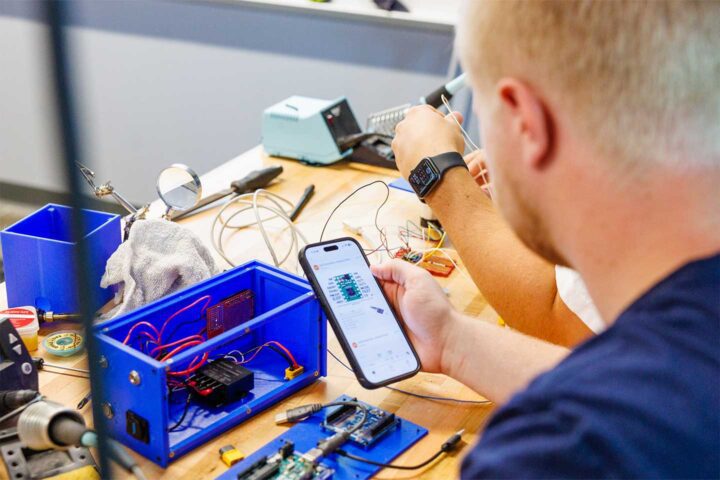
What can you do with a degree in engineering?
Engineering degree careers An engineering degree can lead to more career paths than you might realize. Earning a bachelo...
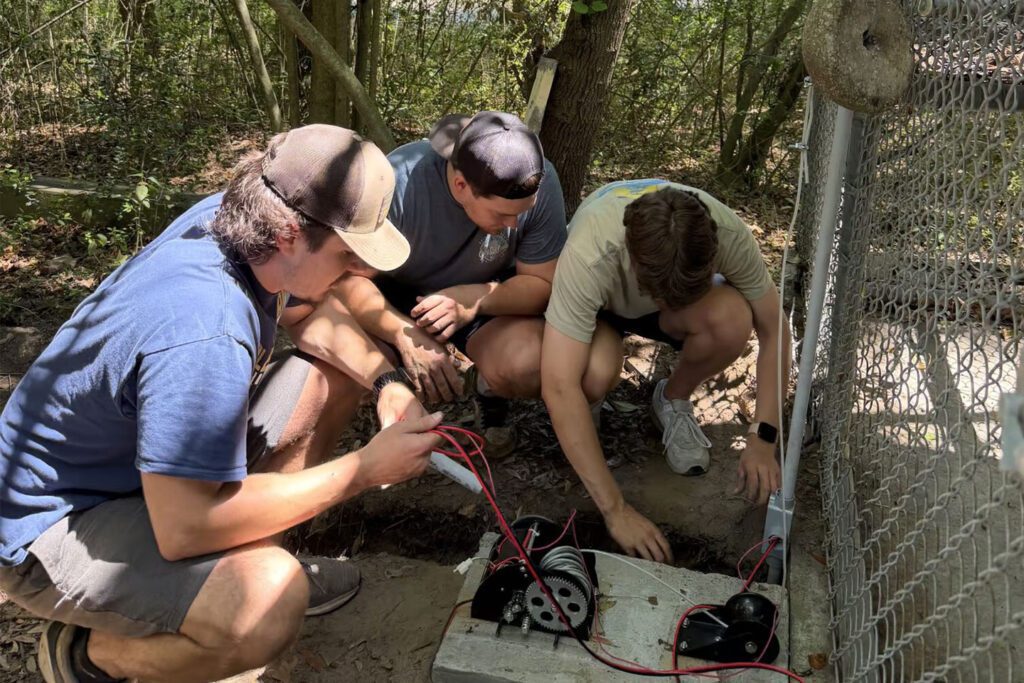
Installation of engineering students' senior project at Charles Towne Landing. Photo by Nate Austin.
For their senior project, students in Charleston Southern’s engineering program have partnered with Charles Towne Landing Animal Forest.
The students developed technology to make caring for the red wolves more seamless. This has given them the opportunity to apply what they have learned in the engineering classroom to create systems that can be used beyond campus.
The students worked in two groups, each working on a different system to help the Animal Forest. One group developed a system to remotely open a gate between two parts of the enclosure. The other group worked on a method to obtain the weight of a wolf as they walk across a scale without disrupting their routine behavior. The students have also collaborated with the Naval Information Warfare Center (NIWC) – Atlantic to manufacture parts for the systems they designed.
Engineering student Matthew Lauer is in the scale group. He explained how having this opportunity has helped to prepare the students for jobs they may have in the workforce, and for working as a team.
“A cool aspect of the program is that we are obtaining a general engineering degree, but we are concentrating on particular things for the project. We are able to come together better because we all have a foundation of general engineering knowledge. It makes the dynamic good to ping ideas off of each other,” said Lauer.
Throughout the project, students have been able to bring their individual strengths and perspectives together to be able to move the design forward, practice trial and error, work on coding, and more. Lauer focused on the mechanical side of the project, and another member of his group, Esdras Juarez, focused on the electrical side.
“If you don’t plan for things to go wrong, you’re not really planning,” said Juarez.
Dr. Joel Chapman, associate professor of mechanical engineering and project supervisor, shared how real-world responsibilities help the students, and what he hopes students gain through this experience.
The connection between the CSU engineering program and Charles Towne Landing first came about when Chapman reached out to Dr. Todd Heldreth, CSU professor of biology and the veterinarian at the Charles Towne Landing Animal Forest.
Heldreth said the project helps bring awareness to the national effort through the U.S. Fish and Wildlife Service to restore the red wolf population.
“Education is critical in saving a species,” Heldreth said.
Not only are CSU’s engineering students gaining significant experience through this opportunity with Charles Towne Landing to develop these impactful systems but also the project helps to bring awareness to the red wolf program.
Technical aspects of the engineering projects:
One group developed a new system for remotely operating a gate between two portions of the red wolf enclosure. The current manually operated gate requires staff to approach the enclosure, creating safety risks and increasing domestication of the critically endangered wolves. Through extensive background research, ethical analysis, and engineering evaluations, the design team identified the need for a remote or autonomous gate system that enhances safety, reduces human-animal interaction, and aligns with legal regulations.
The second group worked on a method of obtaining weight of the red wolves in a noninvasive manner while the wolves go about their business in the enclosure. The project addresses the need for a noninvasive method of obtaining health data on the red wolves at Charles Towne Landing, where the wolves are intentionally kept nondomesticated due to the possibility of future release into the wild. Because the wolves’ handlers wish to avoid sedation or other disruptive handling that would typically be required for obtaining weight measurements, the team sought a weighing system that allows the wolves to be weighed autonomously while still providing accurate, usable data.
Kaylee Allen, author, is an intern in the CSU Marketing & Communication Office and is majoring in communication.
Learn more about Engineering at Charleston Southern University.

CSU Media features are created by staff, faculty, or guests of Charleston Southern University in collaboration with the Office of Marketing & Communication.

Engineering degree careers An engineering degree can lead to more career paths than you might realize. Earning a bachelo...

Criminal justice degree careers Having a degree in criminal justice opens more doors than people realize. While most thi...

Computer science degree careers In a world where technology continues to shape how one lives, a computer science degree...