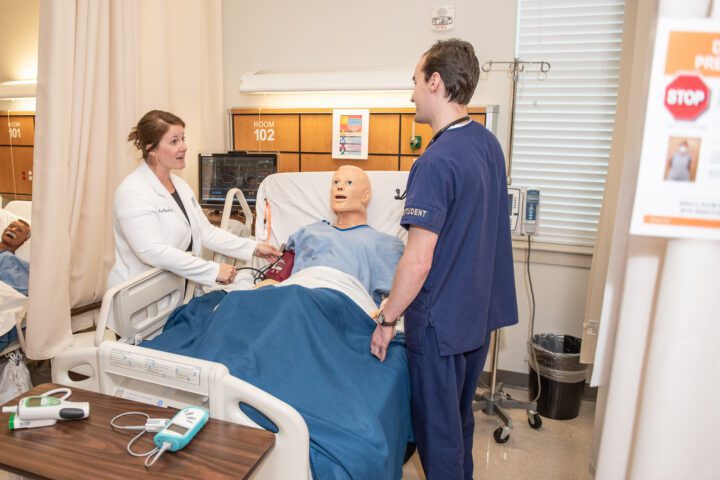
CSU Named Among Top Universities for Undergraduate Teaching; Nursing Ranked Nationally
National recognition highlights CSU’s commitment to preparing students for meaningful work and purposeful lives Charle...
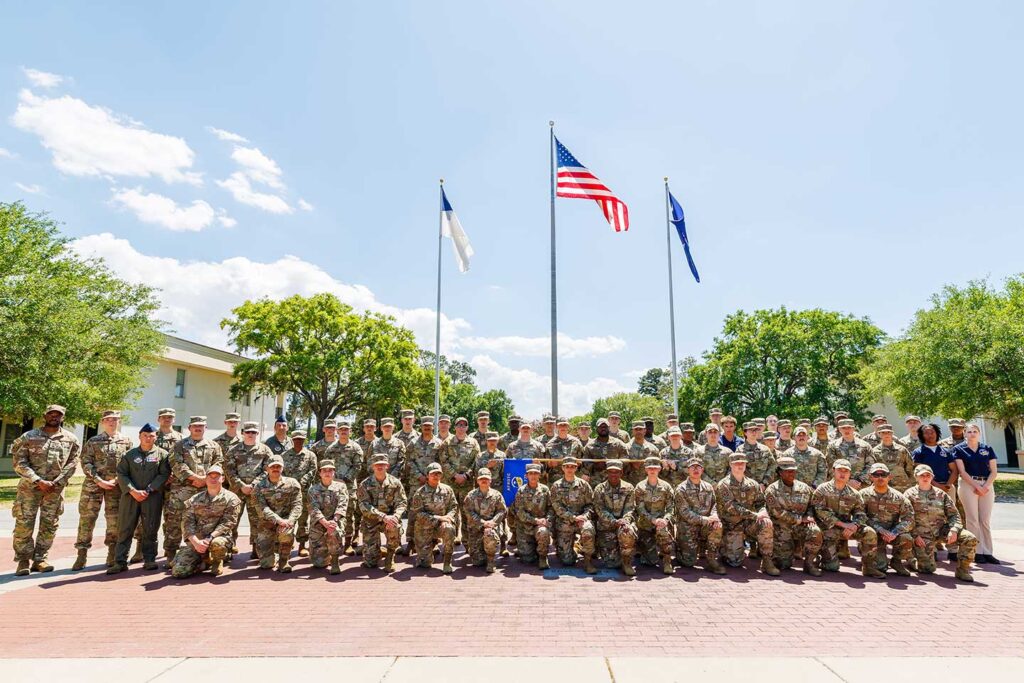
AFROTC Detachment 772
Air Force ROTC Lieutenant Colonel Adam Glover is busy preparing for the arrival of new cadets at Charleston Southern University. New semester. New experience. New opportunities.
To hear Glover describe his work, his voice has an unmistakable sense of joy and energy. His pace quickens; his passion is infectious and inspiring.
With the new academic year quickly approaching, and a renewed sense of excitement washing over Charleston Southern, Glover confessed his “greatest joy” comes from the confirmation that God has placed him in Charleston, at this university, at this time, to serve the next generation of leaders.
“When cadets graduate and are commissioned, they reach out to me and say, ’Thanks. The experience was awesome. You’ve done a great job getting us prepared.’ That is what I really love. It shows me I’m doing the job I need to be doing.”
When Glover accepted the role as CSU’s AFROTC Detachment Commander in the summer of 2024, he began assessing the services and space CSU offered. “I was surprised how small the detachment was,” he said. “Charleston is growing, and with Boeing, the base right here, and so many Air Force JROTC programs at high schools, I was really surprised.”
To put that in context, 145 universities have a host program. Glover said those detachments include small (20-70 cadets), mid-sized (70-110 cadets), and large (110+ cadets).
From 2019–2024, the program averaged 45 cadets per year. Glover went to work recruiting, attending First Look events and Accepted Students Weekend to build awareness of the AFROTC program.
One year later, in fall 2025, the hard work paid dividends when the Det 772 freshman class set a record for the largest number of new cadets joining the program (82).
“The Air Force in general is seeing a desire to serve again,” said Glover, a Fort Mill native and a 2006 Georgia Tech graduate.
As his first year as Det Commander ended, Glover received the news that the Air Force ROTC Detachment 772 at Charleston Southern University was awarded the Southeast Region’s Academic Year 2024-2025 High Flight Award, which was among the top four small detachments in the country. The last time CSU won the award was in 2009.
The Right of Line Award, the national level winner, assesses programs based on an assessment of five key areas: production, education, retention, community relations, and activities. The Award is given to the national winners from small, medium, and large detachments. CSU’s program fell just short, earning runner-up in the small detachment category.
All marketing and PR aside, Charleston Southern has stacked the deck in its favor.
In addition to the Lowcountry lifestyle, Christ-centered academic vision, and a community that thrives in aeronautics training and professional development, the university offers an accredited Federal Aviation Administration (FAA)-certified Bachelor of Science in Aeronautics with an emphasis in Air Traffic Management, Aerospace Management, Aeronautics: Professional Pilot, and a Bachelor of Technology in Aviation Maintenance Management.
“A large portion are coming in with a desire to either be a pilot or do like an RPA pilot, like a drone pilot for the Air Force,” said Glover. “When we talk about being an RPA pilot, there are a lot of people that connect with that because they’ve done that kind of thing on a small scale before. And so, we’re seeing a big increase in people that want to do both.”
The strategic collaboration among CSU’s technology, aerospace, and ROTC programs is growing enrollment and raising the university’s profile.
“In my first year, we made sure students were getting a quality education that is preparing them for the active-duty side,” noted Glover. “But I think it is the cadet activities that really set us apart.”
For the first time in program history, CSU attracted a four-star general to visit the university. General Thomas A. Bussiere, a retired Air Force Global Strike Commander, shared valuable insight into what it means to be an officer.
“He met with our university leadership, but he spent about four hours with our cadets,” said Glover. “Not only our cadets here, but also the University of South Carolina and Citadel cadets. General Bussiere had an opportunity to really mentor, shape, and provide leadership. We had big leadership people coming and speaking to the cadets.”
In addition, Detachment 772 also welcomed Chief Master Sergeant Chad Bickley, the Air Education and Training Command chief, who spoke with the cadets and shared his perspective on what it means to be a leader and an officer.
Tyson LeClaire, a self-proclaimed military “brat,” arrived at Charleston Southern as a candidate for pilot training. There are three phases in pilot training: academic, simulator, and flying.
“He struggled on the academic side,” noted Glover. “He reached out and said, “I’m not doing well. Would you write me a letter of recommendation to help me get back into training?”
That’s when Glover stepped in and wrote a letter of recommendation on LeClaire’s behalf to the commander. The request earned LeClaire a second chance to prove himself.

“From that moment on, he put every bit of effort he had into it, and he just found out he’s going to be a C-17 pilot,” said Glover. “I’m incredibly proud of him for his resilience and responding in that great way to be able to push through and just to be able to get to the goal of being a C-17 pilot.”
Tyson’s father, Brian LeClaire, served as a flying crew chief and later as quality assurance over C-17s at Joint Base Charleston. LeClaire, who retired as a senior master sergeant, encouraged his son to follow suit, pointing Tyson to the aeronautics program.
“My senior year of high school, my Dad told me CSU was launching an aeronautics program,” said Tyson. “I was like, that sounds awesome because I don’t want to fix the planes. I’d much rather fly them.”
Tyson LeClair completed his pilot training in July in Mississippi, then … “I’ll either go straight to the training base in Oklahoma, or I’ll get sent to my first base and wait for a training assignment,” he said. “But what I do know is I’ll be flying a C-17.”
Like Father, Like Son.
“When I graduated from the ROTC program at Georgia Tech, I had such a great active-duty cadre team growing us into leaders that I wanted to be that person for somebody else,” said Glover. “I told myself, if I ever get the opportunity at the end of my active-duty Air Force career to go back and be an Air Force ROTC instructor, that’s what I want to do.”
Glover’s active-duty service in the Air Force stretches across 18 years. After graduating from Georgia Tech, he was assigned as a C-17 pilot at Joint Base Lewis–McChord (JBLM) in the Pacific Northwest, eventually landing his first assignment in Seattle.
In 2012, Glover moved from Seattle to Joint Base Charleston and the 16th Airlift Squadron before becoming a C-17 instructor and an evaluator in Altus, Oklahoma, where he trained cadets to become aircraft commanders, instructors, and airdrop specialists.
Glover left Oklahoma for New Jersey to attend the Air Force Institute of Technology to be part of the Advanced Studies of Air Mobility, a specialty program where he earned a master’s degree in transportation and air supply management and received the award for best dissertation.
I went to a staff assignment for Air Force Central Command at Shaw Air Force Base in Sumter, South Carolina. “I had done flying and air mobility, and now I oversaw all aircraft in the Middle East. I matured as an Air Force officer during that time.”
Glover eventually returned to Oklahoma and was assigned director of operations for the C-17 squadron; the number two guy under the squadron commander. “But after that job, I was selected to become the operations support squadron commander,” he said. “I had 175 people. We were doing weather, tactics, aircrew flight equipment, intel, and airfield management—air traffic control and RAS. That was my role.
After 18 years of service, 3,500 C-17 flight hours, five major deployments (including the Middle East, Europe, and Asia), and the experience of being a C-17 instructor and evaluator, Glover began asking what’s next? He never forgot his roots and the promise he made to himself to “go back and be an Air Force ROTC instructor.”
That’s when Charleston Southern appeared on his radar. He was a perfect fit.
“I was blessed to come to Charleston Southern,” he said. “The university aligns with my personal values and my beliefs. To be here and grow cadets into leaders for the Air Force.
“I want to make sure that we’re putting Charleston Southern on the map as a place to be able to come to become a pilot, an RPA pilot, and find a place to serve and do it in a Christian environment,” said Glover. “I want to continue to develop a program of the highest quality that produces officers who are immediately ready to enter the Air Force and succeed.”
The role of Lieutenant Commander in the AFROTC is typically a three-year term. Glover, now starting his third full year in fall 2026, was recently approved for an extension that includes a fourth year, keeping him in Charleston through the 2027-28 academic year.
John Strubel, author, is a journalist based in Charleston, South Carolina, and CSU’s former director of integrated marketing.
Learn more about the Air Force ROTC at Charleston Southern University.

CSU Media features are created by staff, faculty, or guests of Charleston Southern University in collaboration with the Office of Marketing & Communication.
National recognition highlights CSU’s commitment to preparing students for meaningful work and purposeful lives Charle...

As National PA Week comes to a close, Charleston Southern University PAs reflect on a service trip to the Dominican Repu...

Charleston Southern University is pleased to announce the appointment of Dr. Janet B. Tankersley as dean of the College...