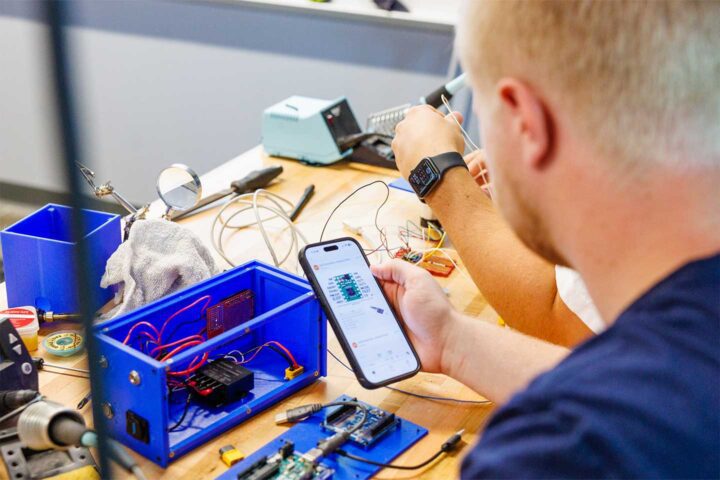
What can you do with a degree in engineering?
Engineering degree careers An engineering degree can lead to more career paths than you might realize. Earning a bachelo...

Spanish is needed now more than ever. In today’s world, it is an essential tool for communication, education, as well as missions. “Hispanics make up 20% of the U.S; population and 8% of the population of S.C., so a degree in Spanish would not only make you more valuable and marketable in many careers; it is quickly becoming a necessity in many fields,” explains Andrew Tabor, instructor of Spanish at Charleston Southern University.
Having a degree in Spanish opens up a world of possibilities.
Let’s break down some of these careers:
By far one of the most needed jobs in Spanish is translating. “If the student achieves a high level of fluency, there is legal/court, document, medical/health fields, and other forms of in-person and online translation opportunities,” said Tabor.
Especially in the Charleston area, being fluent in Spanish as a tour guide could be beneficial. There’s always a need for tour guides in the historic parts of Charleston and with the Hispanic population growing every day, you can help people who only speak Spanish understand Charleston better.
A transcriptionist is someone who listens to audio and then translates it for Spanish-speaking people. Or vice versa, you can translate Spanish audio into English for English-speaking people. This career could be in a courtroom, hospital, business, or a church.
People who only speak Spanish might sometimes feel like an outsider in a predominately English-speaking community. Having someone who speaks Spanish can make them feel more at home.
An interpreter is someone who interprets to other people what someone is saying. Just like a transcriptionist, it could be from Spanish to English, or English to Spanish. This career could also be in places like a courtroom, hospital, business, or a church.
As Sullivan said, a degree in Spanish can lead you to working in the school system. “Students can use this degree along with certifications in education to teach Spanish at the elementary and high school levels. They can also teach English as a Second Language courses in those same institutions, in community centers, or with governmental agencies,” said Tabor. He explained, some careers do need more certification; however, there are careers in the education system that you can get with a bachelor’s degree.
An ESL (English as a Second Language) teacher uses both English and Spanish to communicate. While the teacher is teaching the students English, sometimes talking to them in Spanish can help them feel more comfortable and allow connection with them. This career is not just in schools, as Tabor explained. It can be in community centers and governmental agencies.
This is a good career if you want to help students more individually. By becoming a Spanish tutor, you have the opportunity to help students who may be struggling in Spanish. Or you could tutor Spanish-speaking students who are struggling with learning English.
If you don’t want to teach but still do something in education, working with international students could be a way to go. You can help international students adjust by helping them connect with other students. It also helps the student feel more at home knowing there is someone who understands them.
If you are someone who wants to share your faith with Spanish-speaking people, working in missions might be for you. A missionary is someone who spreads their faith by evangelizing and teaching the gospel to those around them. A missionary can be anywhere, from your hometown to a different country. They focus on helping others understand what the gospel is and how it can change their life.
Becoming a missionary in a Spanish-speaking country or in a primarily Spanish-speaking area in the U.S could be a great career for those who are looking to integrate their faith into their job.
“Getting a degree in Spanish at CSU prepares you for a wide variety of careers or can also better prepare you to get a position where the language is not the main goal, but knowing Spanish would be a true asset,” says Andrew Tabor, CSU Instructor of Spanish.
Adrienne Antley, author, is an intern in the CSU Marketing & Communication Office and is a double major in communication and public health.
Learn more about Spanish at Charleston Southern.

CSU Media features are created by staff, faculty, or guests of Charleston Southern University in collaboration with the Office of Marketing & Communication.
Engineering degree careers An engineering degree can lead to more career paths than you might realize. Earning a bachelo...

Criminal justice degree careers Having a degree in criminal justice opens more doors than people realize. While most thi...

Computer science degree careers In a world where technology continues to shape how one lives, a computer science degree...