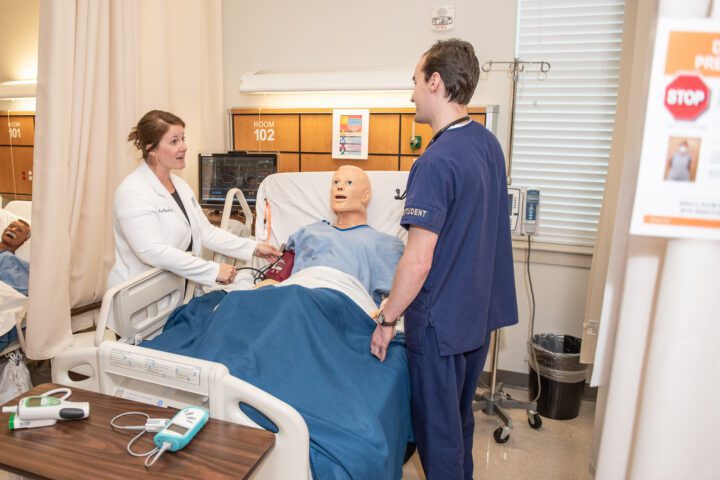
CSU Named Among Top Universities for Undergraduate Teaching; Nursing Ranked Nationally
National recognition highlights CSU’s commitment to preparing students for meaningful work and purposeful lives Charle...

Chemistry is everywhere. It’s in medication, in food, in cosmetics, and even in batteries that power devices. When it comes to these everyday essentials, there are professionals who use chemistry to solve problems and to improve lives. Having a career in chemistry offers many opportunities to make an impact in industries and companies that touch nearly every part of modern life.

Chemistry is the scientific study of matter, what everything is made of, its properties, and how it interacts and changes. It explores the composition, structure, and properties of substances. Chemistry affects almost everything one sees and does.
More than what most people might think.
A chemical technician is the helper to scientists and engineers. They are responsible for setting up and monitoring experiments, testing materials to make sure they are safe, and operating lab equipment. They use problem solving and critical thinking to run daily tests and to monitor production in the lab.
A water chemist is a scientist who analyzes and studies materials and the quality of water. They make sure the tap water is safe to consume by checking for things like bacteria, minerals, and pollutants.
An analytical chemist studies materials and substances to figure out what they are made of and what ingredients are present in it. They test food for safety, check if water is safe to consume, and ensure that medications have the right dosage by using specialized lab equipment.
A synthetic chemist combines chemical ingredients to create new materials or to replicate compounds. They build products from scratch, such as medicines, plastics, and fuels. They can develop materials for nearly any industry which can include healthcare, manufacturing, and food.
A quality control chemist or a QC chemist, tests materials and ingredients during the production process to ensure they are safe and effective. A QC chemist uses the methods that an analytical chemist established to test them.
A hazardous waste chemist is a scientist who identifies, tests, and monitors dangerous chemical pollutants in the air and water. They figure out what a hazardous substance is and then ensure it is stored or disposed of safely so it will not harm public health or the environment. They also sometimes develop parts for more efficient ways to manage hazardous materials.
Oceanographers are scientists who study the oceans and research marine ecosystems. They research and perform scientific studies on topics like marine life, geology, water compounds, and more to do with the ocean. The work they do helps others understand the ocean better and how to protect it.
A material scientist studies and analyzes exactly what physical things are made of, and how to make them better. The findings can be used to develop or alter materials.
A forensic scientist uses science to collect and analyze evidence from a crime scene. They analyze the evidence, identify things like DNA, fingerprints, and write reports. They are responsible for reporting and presenting their findings in legal cases in a courtroom.
Life and career skills like analytical thinking, problem solving, and technical skills that are gained through studying chemistry prepares graduates to face real world challenges and how to adapt to a rapidly changing workforce.
Having a degree in chemistry can turn into a very rewarding and impactful career, with endless potential.
Classes one would take with this degree are College Chemistry, Organic Chemistry, Physical Chemistry, Quantitative Analysis, Chemical Research, and more. Chemistry majors also have the opportunity to conduct research with faculty members.
Adrienne Antley, author, is an intern in the CSU Marketing & Communication Office and is a double major in communication and public health.
Learn more about Science at Charleston Southern.

CSU Media features are created by staff, faculty, or guests of Charleston Southern University in collaboration with the Office of Marketing & Communication.
National recognition highlights CSU’s commitment to preparing students for meaningful work and purposeful lives Charle...

Engineering degree careers An engineering degree can lead to more career paths than you might realize. Earning a bachelo...

Criminal justice degree careers Having a degree in criminal justice opens more doors than people realize. While most thi...